Introduction
Most real estate teams do not fail at lead generation because they lack channels. They fail because they buy tools that produce activity, not qualified pipeline.
That is the core challenge when evaluating ai lead generation tools real estate teams are considering today.
The right tools can improve targeting, response speed, and qualification consistency. The wrong tools can inflate lead volume while conversion quality drops.
This comparison guide is built for high-intent buyers searching for the best ai lead tools real estate workflows can support right now.
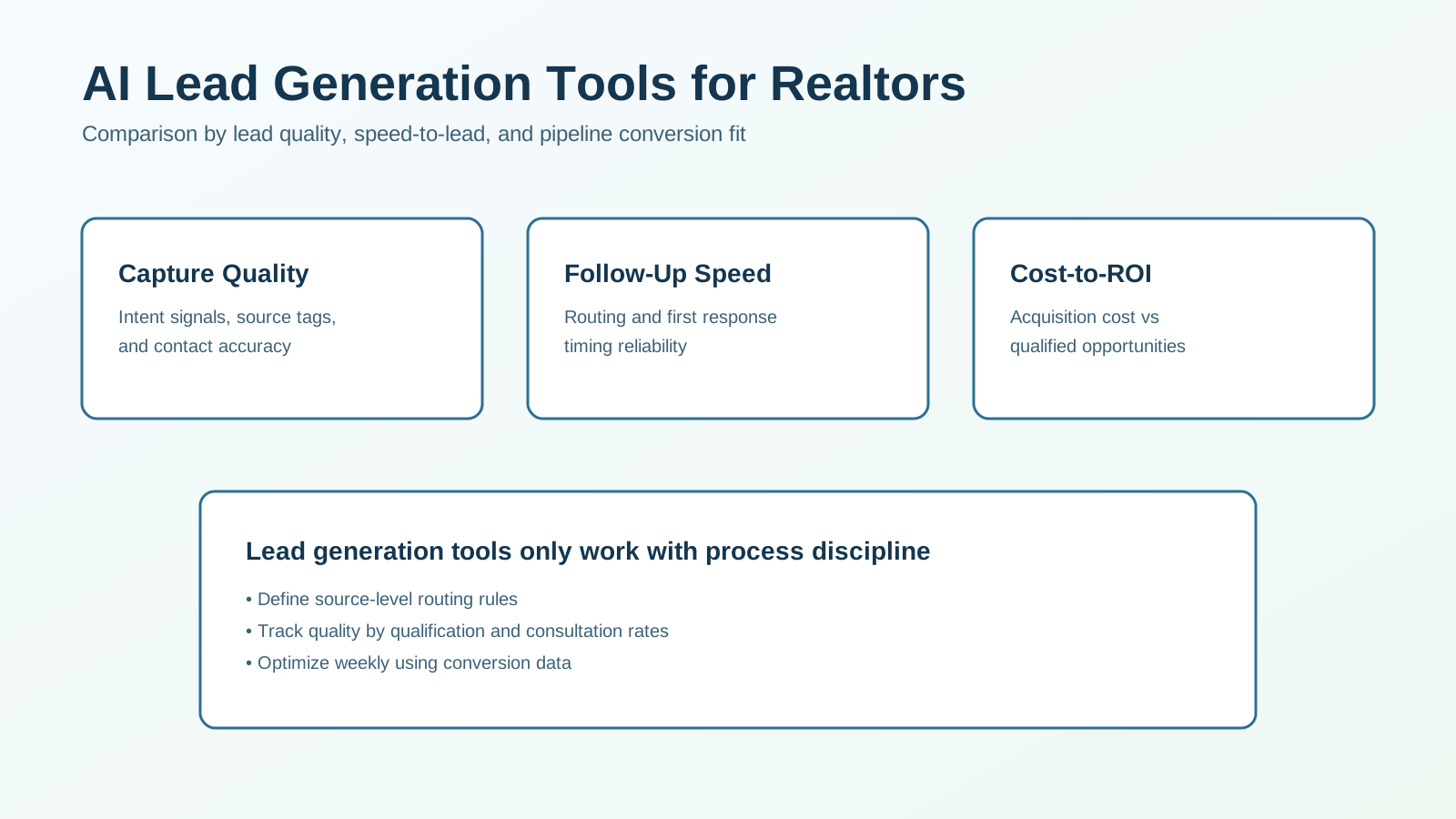
What This Article Compares
This is a commercial evaluation across practical tool categories used by agents and teams:
- inbound lead capture and enrichment tools,
- conversation and first-touch AI tools,
- CRM follow-up and qualification automation,
- outbound prospecting and nurture tools,
- orchestration and reporting layers.
The objective is to choose tools by operational fit and ROI potential, not by feature count.
Quick Recommendation (If You Need to Decide Fast)
For most teams, the best starting stack is:
- one lead capture source with clean tagging,
- one immediate follow-up automation workflow,
- one qualification process tied to CRM stages,
- one weekly reporting dashboard.
Tool categories should be layered in that order. If you skip sequence and governance, performance usually stalls.
Evaluation Criteria That Predict Real Outcomes
1. Lead Quality Signal Depth
Does the tool capture useful intent data or only basic contact information?
2. Speed-to-Lead Capability
Can leads be routed and contacted within minutes without manual lag?
3. Qualification Workflow Fit
Can the tool support practical readiness checks and branch logic?
4. Integration Reliability
Does it connect cleanly to your CRM, forms, and messaging channels?
5. Reporting Clarity
Can you trace outcomes by source, segment, and stage?
6. Cost per Qualified Opportunity
Measure value by qualified consultations and clients, not raw lead counts.
Tool Categories and Tradeoffs
| Tool category | Best for | Main tradeoff |
|---|---|---|
| AI-enabled ad and funnel tools | Top-of-funnel lead volume and targeting tests | Lead quality can vary without strict filtering |
| Conversational AI/chat capture tools | 24/7 initial engagement and data collection | Needs strong handoff to avoid stalled conversations |
| CRM-native lead automation | Fast routing, stage movement, and SLA control | Advanced personalization may be limited |
| Outbound AI prospecting tools | Reactivating dormant lists and niche targeting | Requires careful compliance and message controls |
| Workflow automation platforms | Connecting channels and reducing manual handoffs | Can become complex without documentation |
No category is a complete solution alone. Performance comes from how these layers connect.
Side-by-Side Scorecard for Trials
Use this rubric for a 2-4 week pilot.
| Criteria | Strong (5) | Acceptable (3) | Weak (1) |
|---|---|---|---|
| Lead intent quality | Clear timeline/readiness signals | Partial qualification context | Minimal context beyond contact info |
| Routing speed | Under 5 minutes consistently | Same-day but inconsistent | Delayed, mostly manual routing |
| Qualification flow | Branching and stop-rules supported | Basic sequence only | No practical qualification automation |
| Team usability | Fast adoption and clear ownership | Moderate training burden | Frequent workarounds and confusion |
| Reporting utility | Source-to-stage visibility | Partial funnel tracking | No reliable attribution |
Choose tools that score high in usability and reporting, not just lead volume.
Category Deep Dive
1. Inbound Lead Capture and Enrichment
Best use case:
- teams running multiple paid and organic sources,
- teams needing cleaner source attribution.
What to prioritize:
- required field quality,
- deduplication logic,
- source/campaign tagging standards.
Weak capture design creates downstream conversion noise.
2. Conversational AI and First-Touch Tools
Best use case:
- teams with after-hours inquiries,
- teams missing response-time targets.
What to prioritize:
- immediate acknowledgment quality,
- simple qualification prompts,
- automatic pause on human reply.
Fast but generic messaging lowers trust. Context matters.
3. CRM-Native Lead Automation Tools
Best use case:
- teams with inconsistent ownership and handoff discipline,
- teams scaling beyond manual follow-up.
What to prioritize:
- branch logic by readiness,
- task escalation rules,
- stage-level SLA reminders.
This layer usually drives the fastest conversion impact.
4. Outbound and Reactivation AI Tools
Best use case:
- teams with dormant databases and stale leads,
- teams running targeted reactivation campaigns.
What to prioritize:
- segmentation control,
- personalization depth,
- opt-out compliance handling.
Outbound success depends heavily on list quality and cadence discipline.
5. Workflow Orchestration and Reporting
Best use case:
- teams using fragmented systems,
- teams needing cross-tool reliability.
What to prioritize:
- clear trigger ownership,
- failure alerts,
- weekly KPI reporting cadence.
Without this layer, teams often lose visibility across tools.
Cost Structure and ROI Reality
Typical cost pattern:
- low-to-medium: general lead capture and lightweight chat tools,
- medium: CRM automation and routing systems,
- medium-high: multi-channel outbound platforms,
- variable: orchestration layers based on automation volume.
ROI usually appears first in:
- faster first-response times,
- better qualification routing,
- improved consultation booking rates.
If lead volume rises without qualification gains, your system is misconfigured.
Common Buying Mistakes
Mistake 1: Selecting by Lead Volume Alone
Fix: evaluate by qualified appointments and conversion, not top-of-funnel count.
Mistake 2: No Source-Level Ownership Rules
Fix: define routing ownership and backup logic before launch.
Mistake 3: No Stop Conditions in Follow-Up
Fix: pause automation immediately on lead reply or human takeover.
Mistake 4: Too Many Tools, No Operating Standard
Fix: launch one core stack first, then add layers only after KPI gains.
90-Day Implementation Sequence
Phase 1 (Weeks 1-3): Foundation
- choose primary lead source stack,
- standardize intake fields,
- configure immediate follow-up trigger.
Phase 2 (Weeks 4-8): Qualification and Routing
- launch readiness-based branching,
- implement handoff and escalation tasks,
- audit source-level quality weekly.
Phase 3 (Weeks 9-12): Optimization
- refine templates by reply performance,
- adjust routing thresholds,
- optimize spend by source-to-client conversion.
This phased model usually outperforms a broad all-at-once rollout.
KPI Dashboard: What to Track Weekly
Track these core metrics:
- median speed-to-lead,
- reply rate by source,
- qualification rate by source,
- consultation booking rate,
- conversion to active client,
- cost per qualified consultation.
If a tool cannot support these measurements, long-term optimization becomes difficult.
Decision Framework: Which Tool Type First?
Choose capture + follow-up tools first if:
- response delays are your biggest leak,
- source attribution is currently weak,
- lead ownership is inconsistent.
Choose outbound/reactivation tools first if:
- you have a large dormant database,
- inbound volume is stable but conversion is underutilized,
- your team can support segmented campaigns.
For most teams, the first priority should be inbound quality plus speed-to-lead execution.
Frequently Asked Questions
What are the best AI lead generation tools for real estate?
The best stack combines lead capture quality, immediate follow-up automation, and strong CRM qualification workflows.
Do AI lead tools improve conversion automatically?
No. Conversion improves when tooling is paired with clear routing, messaging standards, and weekly optimization.
How should small teams choose tools?
Start with one high-impact workflow and measure qualified appointments before adding more software.
What metric matters most?
For commercial decisions, cost per qualified opportunity is usually the strongest benchmark.
Final Recommendation
The best real estate lead generation stack is the one that produces qualified conversations consistently, not just new contacts.
For most teams:
- prioritize fast lead routing and first-touch automation,
- implement lightweight qualification logic,
- track source-to-conversion metrics weekly,
- expand tooling only after proven ROI.
If you want tool affiliate recommendations based on your lead sources and team size, use our affiliate picks and we can map a shortlist that fits your workflow.